Kanban Guide · New edition v2.1
The Official Guide to the Kanban Method.
New to Kanban? Your easy entry into the Kanban Method: its principles, practices and the Kanban visualization.
Thank you! Download The Official Guide to the Kanban Method below.
Download the guide (PDF) Also get the new English edition (v2.1)- PDF download
- 21 pages
- Version 2.1, November 2026
- A fresh design
- A clickable table of contents
- Interactive links to the glossary
- Outdated links fixed
The content of the guide is unchanged.
What’s inside.
Four chapters and a glossary. Click a chapter to jump to it.
Chapter 01
The Kanban Method
This guide is for you if you are new to Kanban and interested in learning about the basics of the method. That is why we included an introductory metaphor (Kan-Bahn) to help you connect to the concept. Our hope is that this guide provides an easy entry into the vast Kanban body of knowledge.
If you have taken Kanban University classes and want to review certain aspects, we recommend Kanban+ as a reference – you can sign in with your Kanban University account.
What is Kanban?
Maybe the simplest way to put it is: with Kanban, you can manage work. It is a method to manage all types of professional services, also referred to as knowledge work. Using the Kanban Method means applying a holistic way of thinking about your services with a focus on improving them from your customers’ perspective.
With the Kanban Method, you visualize invisible knowledge work and how it moves through a workflow. This helps to effectively operate your business, including understanding and managing risks in delivering your services to the customers. With Kanban, you and your business will develop an adaptive capability over time to respond better and faster to changes in your customers’ needs and expectations or within your business environment.
Kanban is widely known for usage within teams, to relieve overburdening and to (re-)gain control over the work done by the team. While this usually brings quick benefits, applying the Kanban Method at a greater scale, e.g., for a line of service usually encompassing the work of multiple teams or different parts of organizations, brings even greater opportunities. Used with a service focus in mind, Kanban is an effective organizational development tool.
Kanban University is “Home” of the method and the global community of Kanban trainers, coaches and consultants who continue to evolve the method and develop its related body of knowledge.
Method, Methodology, or Framework?
Kanban is often confused with a methodology or framework. In software engineering a methodology is a process definition approach to software development and project management (a bit of a misnomer, as “methodology” should mean “the study of methods”). Methodologies contain prescriptive, defined workflows and processes, including roles and responsibilities. This means that they are usually specific to a domain, such as software development.
A process framework on the other hand is an incomplete methodology – a set of scaffolding that is intended to have broader applicability but requires customization for each context in order to fill in the missing gaps.
Kanban is not a methodology nor a process framework. Rather, it is a management method or approach that should be applied to an existing process or way of working. There is never a question of using Kanban versus a given methodology or framework. Rather, it is always adding Kanban using an existing methodology, framework, or way of working. Kanban is intended to help you manage work better and to improve service delivery to the point where you consistently meet customer expectations. Kanban is a means to improve what and how you already do things. It is not a replacement for what you already do.
The roots of the method are found in Lean Manufacturing. However, Kanban is meant to be used to manage knowledge work resulting in intangible and virtual goods and services. When compared to manufacturing, the Kanban Method views inventory as usually intangible or invisible and has much lower direct costs attached, variability in the delivery of work is accepted as inherent, the workflow is usually less strict, and the focus on waste reduction is of lower concern. Improving the value and flow of goods and services delivered are the initial focus when using the Kanban Method.
In many aspects, Kanban is strongly founded on Lean: the focus on the flow of work, limiting work in progress to establish pull systems, focus on the optimization of the system as a whole rather than managing individuals’ performance, making decisions based on data, and continually improving in an evolutionary way.
Origins
The Kanban Method as described here is based on Kanban: Successful Evolutionary Change for Your Technology Business, by David J Anderson, 2010. The motivation to create the method was mainly to find a way to manage and improve professional service businesses as well as a way to provide a humane change method.
Areas of Application
Kanban is a rather abstract “method without methodology” and has a wide area of possible applications.
It is important to understand that the Kanban Method is applied with its principles and practices on top of an existing flow of work and way of working. The work can be of very different kinds. After being introduced in 2010, there were several examples of Kanban being applied to services in the IT sector. Today, there is an ever increasing amount of examples of Kanban being utilized by marketing agencies, human resources, media and design services, customer support, product development, and education.
Chapter 02
Principles and Practices of the Kanban Method
When using Kanban, the scope of application (e.g., single team, multiple teams, departments, divisions, etc.) can influence the way the method’s principles and practices are applied.
If you have a look at a basic scope within a team for instance, you might find a relatively simple Kanban board with maybe 5 columns indicating the workflow, a few simple metrics and diagrams, a daily held coordination meeting and regular reviews of the team’s work and performance.
Now imagine a whole internal services department within an enterprise, which is managed by a set of Kanban boards relating to each other, placed at different levels of granularity, covering different workflows. The amount of work in progress is limited at different levels.
Both instances are proper usage of the Kanban Method. There is no “right or wrong” in Kanban, rather more or less appropriate adoption of practices given the business context and cultural environment.
The following two sections describe the general Kanban principles and practices.
Kanban Principles
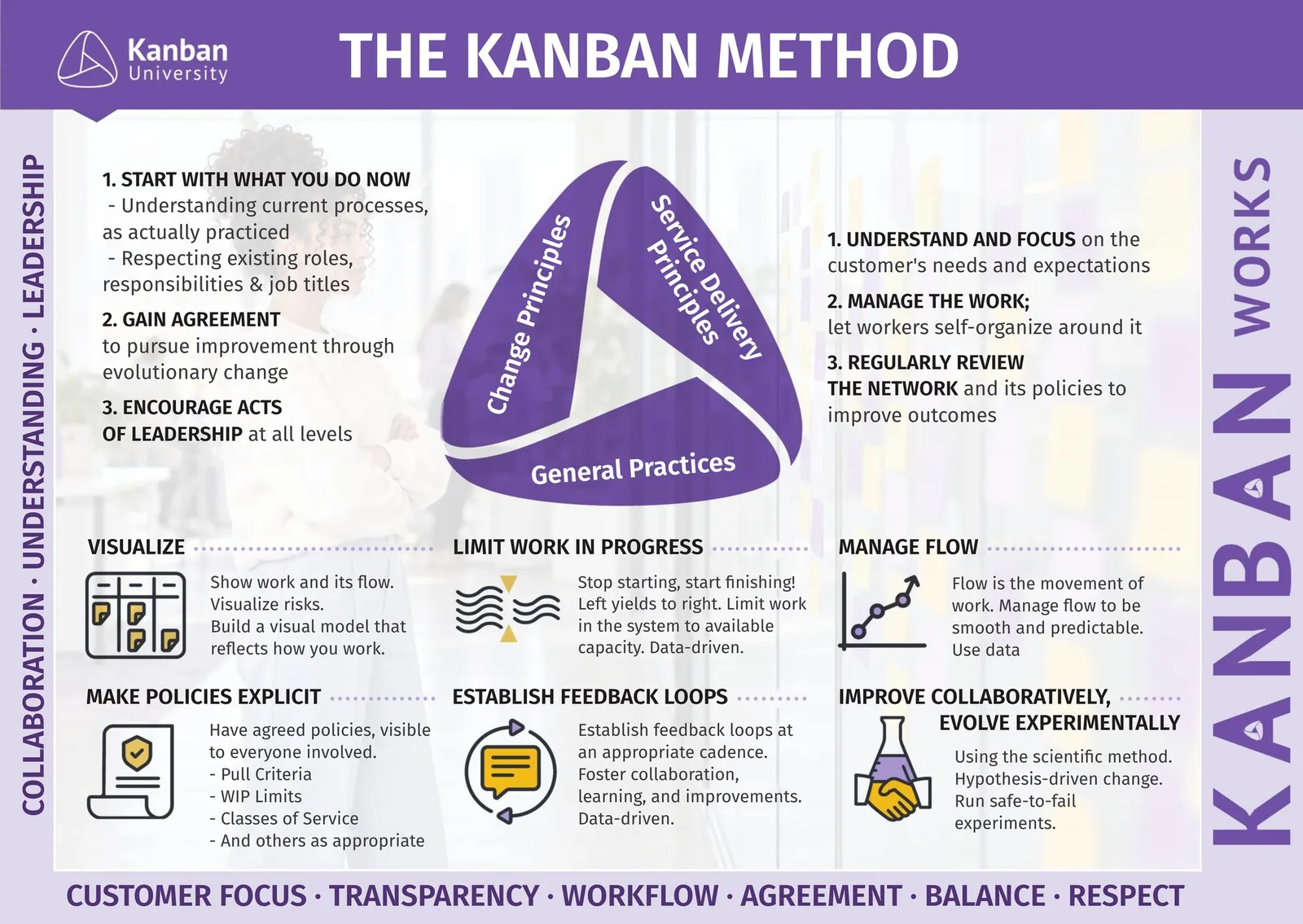
Change Management Principles
These Change Management Principles are common to all Kanban implementations:
- Start with what you do now
- Agree to pursue improvement through evolutionary change
- Encourage acts of leadership at all levels
Kanban is not a big bang transformation going from a current state to some future state. We know from history that those rarely work. Instead, Kanban uses an evolutionary change approach, building on the way of working already in place, seeking to improve it using many forms of feedback and collaboration. The Kanban Method engenders evolutionary change through insights gained by the people working with the Kanban board and taking acts of leadership to continuously improve their way of working. These acts of leadership may not be what are thought of as traditional leadership. They may be small observations and suggestions for improvement by individuals without organizational leadership roles.
Service Delivery Principles
Kanban encourages you to take a service-oriented approach to understanding your organization and how work flows through it. This service-oriented organizational paradigm is based on the idea that your organization is an organic entity consisting of a network of services, each of them living and breathing, and evolving. Customer requests flow through this network of services. If we are to improve service delivery, improvements should be guided by a set of principles. These principles may not be utilized early on by organizations as they may not have developed or evolved a service-oriented or customer service mindset as part of their culture.
The service-oriented principles are:
- Understand and focus on customer needs and expectations
- Manage the work; let people self-organize around it
- Regularly review the network of services and its policies in order to improve outcomes
Manage with Competence.
Lead with Confidence.

Kanban General Practices
As mentioned earlier, the breadth and depth of Kanban practices applied varies greatly. In this section, the six general Kanban practices are described. Later in the guide we go into more details on some of the core specific practices that fall within these 6 general practices. Please refer to the Kanban Maturity Model (KMM) for more details on specific implementation by maturity level.
Visualize
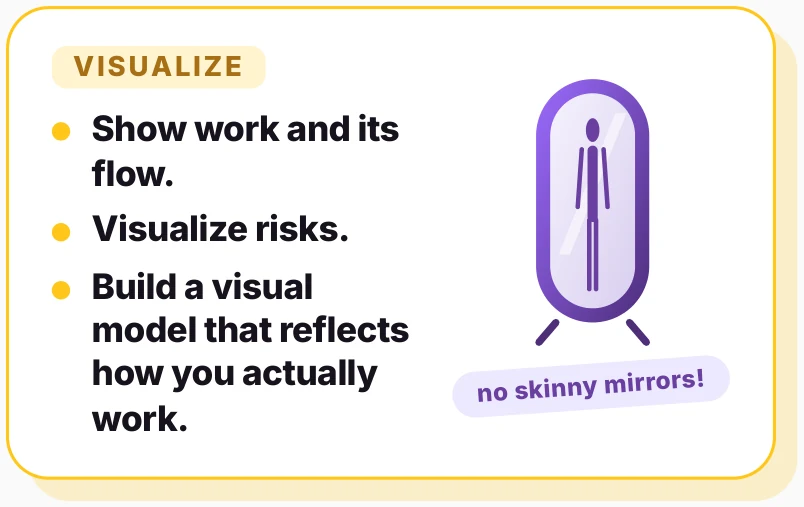
A good visualization is the key to effective collaboration and to identify improvement opportunities. Many times, work in the organization is hidden. Visualizing that work and the flow of that work greatly improves transparency. The human sense of vision is very old from an evolutionary point of view. It allows us to absorb and process a great deal of information in a short time. In addition, visualization supports cooperation, as everyone involved literally has the same picture. More details on visualization are presented in the guide’s section on Kanban boards.
Limit Work in Progress (WIP)
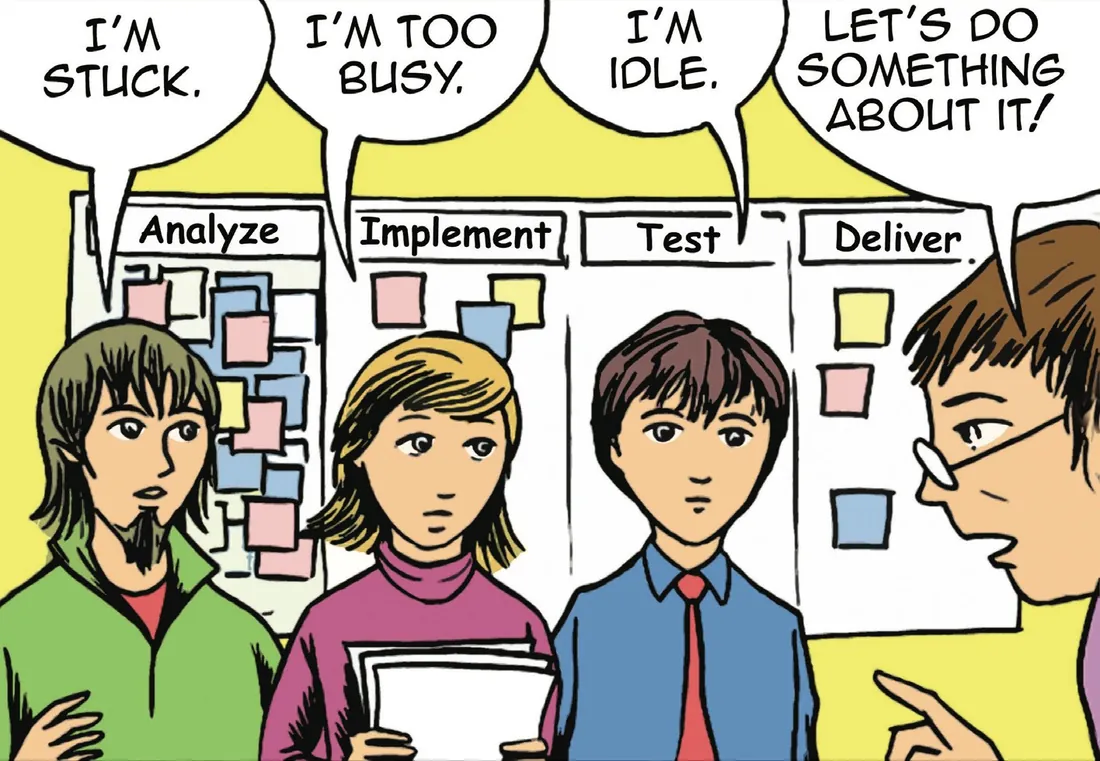
WIP (Work in Progress) states the number of work items in progress at a certain time. Through Kanban we have discovered that effective systems focus more on flow of work and less on worker utilization. When resources are fully utilized there is no slack in the system and the result is very poor flow, just as in rush hour on the freeway. In knowledge work we also have the issue of context switching that can drastically reduce the effectiveness of workers.
In Kanban, we limit the WIP to balance utilization and still ensure the flow of work. The guide later describes WIP limits and how they are used in a “pull system”.
Manage Flow
The goal of managing the flow of work is to complete work as smoothly and predictably as possible, while maintaining a sustainable pace. As mentioned before, limiting WIP is one of the key ways that helps us ensure smooth and predictable flow. The monitoring or measuring of the workflow results in important information that is very useful for managing expectations with customers, for forecasting, and for improvements. This is discussed in the guide’s section on core Kanban metrics.
Make Policies Explicit
Every day, countless decisions are made about the organization of work, either by individuals or between groups of people.
Imagine a new employee starting in your area. Ideally, she will quickly understand how work is organized through explicit policies. These include:
- Policies such as replenishing the board (when, how much, by whom)
- Definition of when a work activity is completed, and the work item can move on (“pull criteria”)
- WIP limits
- Policies for handling work items of different classes of service
- Meeting times and content
- Other principles and collaboration agreements
All of these policies should be agreed to jointly between all parties involved including customers, stakeholders, and employees responsible for work on the board. The policies should be placed in a clearly noticeable area, preferably right next to the board. At team level, a team agreement is a good way to introduce policies. Like all other building blocks of the system, it is necessary to check and adapt these regularly.
Please note that policies are not like work instructions freeing people from the burden to make meaningful decisions. Rather, policies should enable self-organization within the group of people running a Kanban system.
Policies should be:
- sparse
- simple
- well-defined
- visible
- always applied
- readily changeable by those providing the service
Implement Feedback Loops
Feedback loops are required for a coordinated delivery and for improving the delivery of your service. A functioning set of feedback loops appropriate for the given context strengthens the learning capabilities of the organization and its evolution by means of managed experiments.
Some commonly used means for feedback loops in Kanban systems are the board, metrics, and a set of regular meetings and reviews which are referred to as cadences.
Improve Collaboratively, Evolve Experimentally
Back to the Change Management Principles, in the Kanban Method we “Start with what you do now” and “Agree to pursue improvement through evolutionary change.” Kanban is a method for continuous change, and we make those changes collaboratively using designed experiments based on models and the scientific method. This is where feedback and metrics are so important to guide us in the evolutionary path. We design safe-to-fail experiments so that if our hypothesis is correct and the experiment gives good results, we keep the change, but if the results are not positive, we can easily roll back to the prior state.
Chapter 03
“Kan-Bahn” – An Introductory Metaphor
The basic concepts of Kanban will be introduced here by means of a metaphor. Before we start, please consider George E.P. Box’s famous quote “All models are approximations. Essentially, all models are wrong, but some are useful. However, the approximate nature of the model must always be borne in mind”. An international group of Kanban coaches and trainers created this metaphor in 2016 at a Kanban Leadership Retreat in Barcelona.
It is based on an “Autobahn”, a German form of highway, hence the name. Our board (or system) is represented by a highway. Traffic (the work) flows – divided into packages – in the form of different vehicles through our system, a defined section of the route.
Tap the numbers on the poster to explore. The full metaphor, with all 13 concepts, is in the complete guide.
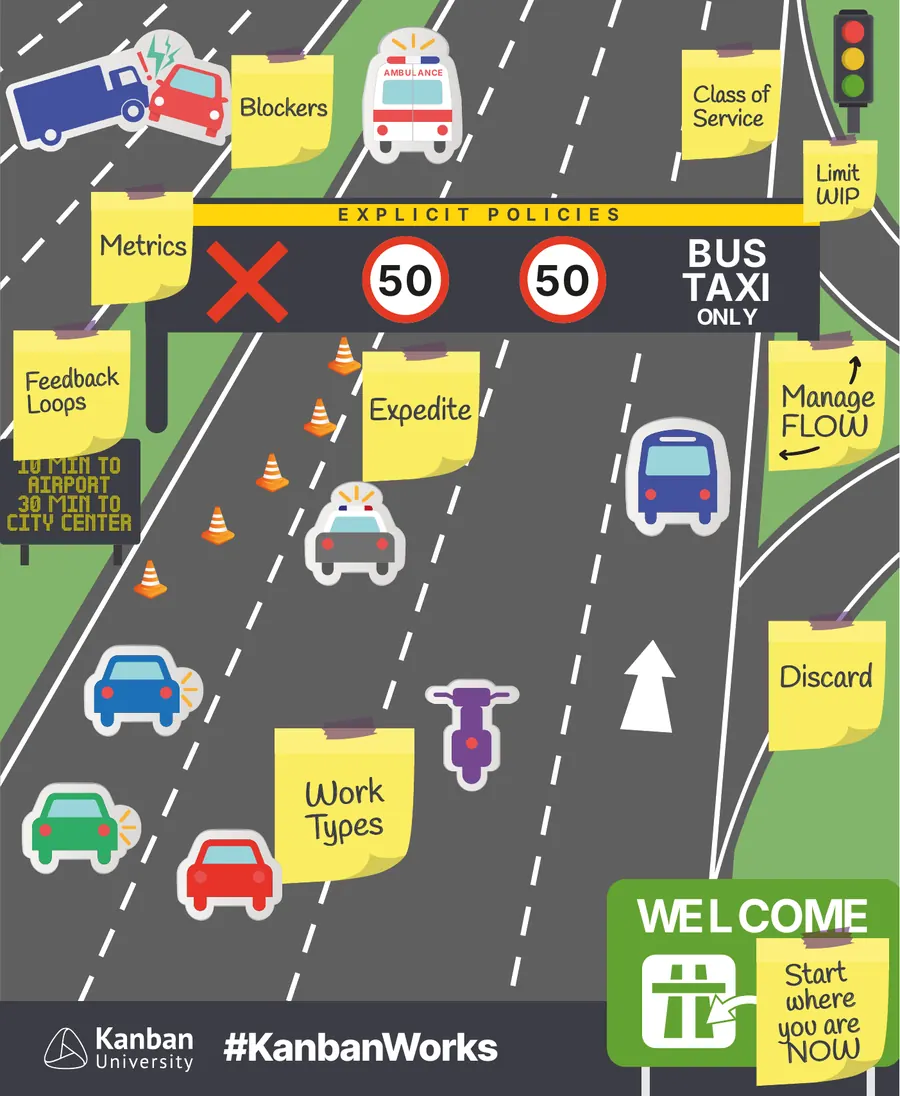
1 / 11
The welcome sign
Kanban is not a big bang transformation going from a current state to some future state. We know from history that those rarely work. Instead, Kanban uses an evolutionary change approach, building on the way of working already in place, seeking to improve it using many forms of feedback and collaboration.
2 / 11
Different vehicles
A grouping of work items that behave similarly and follow the same workflow.
3 / 11
The emergency vehicle
An archetype of a class of service that is applied to work items where the impact of delay is both high and immediate.
4 / 11
Reserved lanes
A specific level of service applied to the treatment of a work item established through a defined set of policies.
5 / 11
The traffic light
A policy that constrains the amount of work allowed in a given part of the kanban system. Limits prevent starting new work when downstream capacity is already utilized and unable to complete the work.
6 / 11
The overhead signs
An explicit description of various agreements that shape how the service delivery works.
7 / 11
The accident
Something that is impeding the flow of a work item. The blockage could be partial or complete.
8 / 11
The sensors
Metrics are a means of feedback to indicate how a system is performing.
9 / 11
The travel-time sign
A feedback loop starts with feedback information about the existing system and then requires action based on whether the result is in line with the desired goals or must be altered in order to improve or align with those goals.
10 / 11
Keeping traffic moving
We focus on managing the flow of the work in order to get smooth and predictable and potentially faster and efficient delivery.
11 / 11
The exit
We wish to vet these options and constrain them against available capacity, also considering their urgency. This frequently results in discarding many of the options prior to service delivery which helps ensure that the service delivery is focused on high value requests.
Chapter 04
Specific Practices
So how do you build your own Kanban system? Let’s learn about some of the Kanban Method’s specific practices.
STATIK
The Systems Thinking Approach to Introducing Kanban (STATIK) is a repeatable and humane way to design a Kanban system for a service. Rather than copying someone else's board, a representative group of the people involved works through six steps: identify sources of dissatisfaction, analyze demand, analyze system capabilities, model the workflow, identify classes of service, and design the Kanban system. The steps are applied iteratively, as a feedback loop rather than a one-pass sequence, and typically take between four hours and four days. The result is a shared view of how the work really flows, and a full system design: board, tickets, metrics, cadences and policies.
Get each of the six STATIK steps in detail in the complete guideKanban Boards
Kanban boards are the most common way to visualize a Kanban system. Work is pulled from left to right: new work items enter on the left, and value is delivered to customers when they exit on the right. Every board shows at least one clear commitment point and delivery point, and how much work in progress is permitted. The columns model the actual workflow, not a wished-for future one, because Kanban starts where you are now. Lanes and card colors can separate work types or clients. A useful board is rarely just To Do, Doing, Done: each Kanban system and board is unique.
See an example board layout in the complete guideWIP Limits and Pull
A WIP limit is the maximum number of work items allowed at one time. It can be set per workflow state, per person, per lane, per work type or for the whole system. Limiting the work that enters the system reduces delay and context switching, and balances demand with capability over time. It also creates a pull system: new work is drawn in only when there is capacity, and pull signals travel upstream as work moves downstream. This is a key difference from traditional, push-based planning, and often a cultural change. A good mantra to start with: "Stop starting, start finishing."
See how WIP limits and pull signals work on a board in the complete guideCore Kanban Metrics
Kanban uses three core metrics. Lead time is how long a single work item takes to pass through the system, from the commitment point to completion. Delivery rate is the number of work items completed per unit of time, such as features per week or new hires per month. WIP is the number of work items in the system at a given moment. These metrics feed charts such as the run chart, the lead time distribution and the cumulative flow diagram (CFD), which help you understand how your system behaves, make delivery more predictable and timely, and find opportunities to improve.
See the run chart, lead time distribution and CFD explained in the complete guideKanban Cadences
Cadences are the regular meetings and reviews that put Kanban's feedback loops into practice. They grow with maturity, so build them up gradually and fit them to your organizational context. Start by identifying existing meetings that already serve a similar purpose, and evolve them. Keep their names or use the standard cadence names: the purpose is what matters. Choose the frequency and duration to suit your context, as more frequent, shorter meetings often increase agility. A common side effect of Kanban initiatives is better-focused, more structured meetings with fewer attendees.
See example team-level and service-oriented cadences in the complete guideThe complete guide
Take the whole guide with you
All four chapters, the full Kan-Bahn metaphor and the glossary in one PDF. Edition 2.1 is available in English; earlier editions are available in Armenian, Bulgarian, Catalan, Chinese, Danish, Dutch, French, German, Italian, Korean, Polish, Portuguese, Russian, Spanish, Turkish and Ukrainian.
Get the guideFrom the guide
Kanban glossary
66 key terms of the Kanban Method, as defined in the official guide.
- No terms found.
Activity
Actions taken in the service delivery workflow that progress a work item to the next step of the knowledge discovery. One or more activities can be visualized as a column in a kanban board.
Blocker
Something that is impeding the flow of a work item. The blockage could be partial or complete.
Bottleneck
A constrained activity that limits the flow and possible delivery rate of the entire workflow.
Cadences
A type of meeting or review providing feedback from one or more services for the purpose of reviewing, coordinating, or improving the work being delivered.
Capability
A measurement of system performance. Measurements may include lead time and throughput. For more information on measurements, please see .
Capacity
Represents the amount of work a kanban system can hold while work is still flowing efficiently. Also used for the allocation to a particular activity, work item type, or class of service.
Card
A visual representation of a work item. A card may also be referred to as a ticket.
Change Management Principles
The Kanban Method approaches evolutionary change using the following three principles:
- Start with what you do now
- Gain agreement to pursue improvement through evolutionary change
- Encourage acts of leadership at all levels
Class of Service
A specific level of service applied to the treatment of a work item established through a defined set of policies. A class of service can apply to one or more work item types. A class of service will often set a service level expectation. The choice of class of service may reflect a relative value, risk, or cost of delay. The four common archetypes of class of service that are widely recognized are:
Commitment Point
The point at which the decision is made to start activities to deliver a work item. Before this point, work done supports the decision whether to deliver the work item (see upstream).
Control Chart
A chart, usually a run chart, showing control ranges outside of which a process may be considered “out of control” in some specific sense.
Cost of Delay
The rate at which the expected value of a product, initiative, or work item decays as its delivery is delayed. Cost of delay involves both urgency and impact. Cost of delay may be used to inform time-related decisions, including the ordering of work items during replenishment or the assignment of a class of service.
Cumulative Flow Diagram
A chart showing the cumulative number of arrivals and departures of work items from each step in the workflow over a time period. The diagram is a quick visual indicator of the stability and characteristics of the workflow in terms of amount of work in progress in the different stages. In general, parallel lines between the steps indicate that the inflow is consistent with the outflow which is good, and deviation is something to be investigated.
Customer
The person, or more likely group of people making the service request and accepting its delivery. Customers can be internal or external to an organization: when one service makes a request to another service within the same organization, the requesting service can be considered an internal customer of the requested service.
Customer Lead Time
Customer lead time is the time between receiving the customer’s request and delivering on it.
Delay
In knowledge work there are a number of potential sources of delay. A work item could be waiting for capacity or it could be blocked due to a defect or a dependency. There are also delays due to switching between different work items in progress, e.g., when a work item has to give way to another work item with higher urgency.
Delivery Rate
See .
Demand
The work requested by a service’s customers. Kanban systems seek to bring demand and capability into balance.
Evolutionary Change
In the Kanban Method, managed evolutionary change is the intentional design of small incremental changes, tested via experiments using the scientific method. The current way of working serves as the starting point, with the goal of being fitter for purpose in a continuously changing environment. Also known as .
Evolve Experimentally
One of the 6 general practices in the Kanban Method. See .
Expedite
An archetype of a class of service that is applied to work items where the impact of delay is both high and immediate.
Experiment
An intentional design to determine if a hypothesis is valid or not. Observations and evidence from the experiment will be used to determine the validity of the hypothesis and what further experiments should be planned. See .
Explicit Policies
An explicit description of various agreements that shape how the service delivery works. Policies can reflect how work items move from one activity to another or can include how a team, individuals, and services interact with each other.
Failure Demand
Demand generated because of previous poor-quality deliverables or demand that never should have been received. Examples can include poor requirements or defects during delivery requiring rework.
Feedback Loop
One of the 6 general practices described as Establish Feedback Loops in the Kanban Method. A feedback loop starts with feedback information about the existing system and then requires action based on whether the result is in line with the desired goals or must be altered in order to improve or align with those goals. Feedback information without action is not a feedback loop.
Fixed Date
An archetype of a class of service that is applied to work items where the impact of delay occurs at a specific date.
Hypothesis
An idea, based on observations, that lends itself to an experiment using the scientific method to determine if the idea is valid.
Intangible
An archetype of a class of service that is applied to work items where the impact of delay is unknown.
Kanban Board
A kanban board is a visual display of cards that represent the work items in a kanban system. Typically, boards are arranged in vertical columns that represent activities. Some boards use horizontal swimlanes to further enhance the visualization of policies, types of work, classes of service, or other attributes that are important for the management of the work. Additional dimensions may be represented by color or other card attributes. Cards move rightward from column to column as the work items they represent progress through the system. Work in progress limits and other policies may be represented visually.
Kanban General Practices
The six general practices of the Kanban Method are:
- [[Limit WIP (Work in Progress)
- Limit WIP]]
- Use Feedback Loops
Kanban Maturity Model
A model describing common patterns of evolutionary change within organizations. The model can serve as a map to organizational agility, resilience and reinvention. See KMM in Kanban+.
Kanban Meeting
A meeting to help the delivery teams coordinate and manage the flow of work. The meeting is held at the cadence appropriate for the team, usually somewhere between daily and weekly. A common approach is to “walk the board”, meaning to look at the work on the kanban board, going from right to left, and ask the questions “what is keeping this item from flowing?” and “who can help?”
Kanban Method
A method for the definition, management and improvement of services that deliver knowledge work.
Kanban System
A model of a kanban service delivery workflow. A kanban system is designed using . A kanban system contains the board, work items represented as cards, policies, metrics, and cadences.
Knowledge Work
Developing goods and services through activities that add to knowledge discovery. Examples of knowledge work are marketing, software development and all kinds of product development. Knowledge work is performed by knowledge workers.
Lead Time
The difference in time (e.g., minutes, hours, days, etc.) between one point in the workflow to another point in the workflow. See and .
Lead Time Distribution
A chart showing the frequency of the observed lead time of work items. Lead times should be consistent, i.e., all system lead times or all customer lead times. Different work item types or different classes of service may have different lead time distributions. The distribution of the lead time can be an indicator of the predictability of the system.
Limit WIP (Work in Progress)
One of the 6 general practices in the Kanban Method. We want to limit work in progress to enable a pull system to improve predictability and flow. When work in progress is not limited, the system can frequently become overburdened resulting in poor throughput, predictability, and quality. Work in progress is commonly limited by work in progress limit policies.
Make Policies Explicit
One of the 6 general practices in the Kanban Method. The practice of defining agreements on how the service delivery will be handled. Examples of policies can include agreements on replenishment criteria, pull criteria, class of service, service level expectations, work in progress limits, and completion criteria. Policies are commonly visualized on or near the kanban board. They can also be stored and shared through various digital tools.
Manage Flow
One of the 6 general practices in the Kanban Method. The point of a workflow is to result in delivery. We focus on managing the flow of the work in order to get smooth and predictable and potentially faster and efficient delivery. To this extent we manage the work, not the workers. Workers are encouraged to self-organize to improve the delivery of the work.
Meeting
A type of feedback loop designed to focus on managing the work. Examples include:
- Team replenishment meeting
- Team kanban meeting
Metrics
Metrics are a means of feedback to indicate how a system is performing. The metrics most used for kanban systems are lead time in different versions, delivery rate or throughput, levels of WIP in various parts of the system, blockers and failure demand. Other metrics such as quality or rework may be quite valuable. Teams should not have too many metrics to start, but at the same time should be cognizant that “you get what you measure”, so collection of metrics should be designed to counter or minimize any gaming of the system while supporting the management of flow. Common visualizations of metrics used in understanding a system are:
- Lead time or delivery rate [[Run Chart
- run chart]]
Option
Prior to the commitment point we have many ideas, requirements, or needs that have come from customers and which may have value. Some people may refer to this as a backlog, but in the Kanban Method we prefer to call the things that may have value options. They are managed in the upstream part of the kanban system. We wish to vet these options and constrain them against available capacity, also considering their urgency. This frequently results in discarding many of the options prior to service delivery, which helps ensure that the service delivery is focused on high value requests.
Overburden
A situation when demand exceeds capacity and demand is not limited by available capacity. Overburdening is commonly observed when work in progress is not limited, resulting in work being pushed into the system.
Pull Signals
A work item in an upstream can be pulled downstream only when capacity is available. The available capacity is the signal. In a kanban system the signal is that the work in progress is below the current work in progress limit.
Pull System
A system for delivering work only when both demand exists and delivery capacity is available. A kanban system is an example of a pull system which uses pull signals to indicate available capacity. WIP limits are the means to implement pull systems in Kanban.
Push System
A system or activity where work is placed into the system without regard to whether capacity is immediately available. The opposite of [[Pull System
- pull system]].
Replenishment
The act of reviewing the requested work items that fulfill the “ready for delivery” criteria and selecting the ones to be pulled into the system based on available capacity.
Review
A type of cadence designed to reflect on the performance or risk of one or more services with a goal to improve service delivery. Reviews are largely performed based on data and observations. Examples include:
- Service Delivery Review
- Risk Review
- Operations Review
Run Chart
A chart that shows an observed metric in a time sequence. Commonly used to visualize the past lead times or delivery rates. One of the main benefits of the run chart is to see any trending of the data. A common question to consider is, “Are lead times going up or down, or within the expected variation?”
Scientific Method
A feedback loop designed to iterate towards a better understanding of a given situation. The steps of the scientific method are:
- Observe
- Collect data
- Analyze results
- Accept or reject hypothesis
- Repeat
Service
A service starts with a customer request, fulfilled through service delivery, which results in acceptance by the customer. From a service perspective, a request can scale from a task to the development of a product, project, or initiative.
Service Delivery
The performance of a series of activities, also known as a workflow, to fulfill customer requests. For example, the activities performed in a service support the delivery of a work item. A service can be managed by one or more kanban systems.
Service Delivery Principles
The core principles of the Kanban Method for service delivery. The principles are:
- Understand and focus on customer needs and expectations
- Manage the work; let people self-organize around it
- Regularly review the network of services and its policies in order to improve outcomes
Service Level Expectation
What can be expected in future service delivery based on prior performance. In knowledge work we have inherent uncertainty and prefer to set expectations based on historical probabilities. If we know that historically we have a stable system that delivers 85% of work items within 10 days, we can set a corresponding Service Level Expectation (SLE) of 10 days with 85% confidence.
Standard
An archetype of a class of service that is applied to work items where the impact of delay is typical of current conditions.
STATIK
An acronym for the Systems Thinking Approach to Introducing Kanban, a recommended approach to introducing Kanban in a new context. It is a “how-to” for designing service-oriented kanban systems. Common activities when using STATIK include:
- Identify sources of dissatisfaction
- Analyze demand
- Analyze capability
- Model the workflow
- Identify classes of service
- Design the kanban system
System Lead Time
The elapsed time it takes for a work item to move from the commitment point to the first column on its kanban board that has no work in progress limit.
Team Retrospective
A type of review focused on exploring potential improvements based on learnings from the past. At higher levels of organizational maturity it is frequently found that this review does not need to exist on its own but becomes part of other reviews and meetings.
Throughput
The number of work items exiting from the system or a given part of it; measured in work items delivered per time period. Throughput is often referred to as delivery rate.
Visualize
One of the 6 general practices in the Kanban Method. We want to make work and its flow visible so that it is not hidden. We also want to make information about the work, its risks or the process visible through such elements as charts.
Work in Progress (WIP)
The work items which have entered the system or activity under consideration and have not exited.
Work in Progress Limit (WIP Limit)
A policy that constrains the amount of work allowed in a given part of the kanban system. Can be applied for instance on columns, swimlanes, per person, or for the whole system. Limits prevent starting new work when downstream capacity is already utilized and unable to complete the work. This is also known as limiting work in progress.
Work Item
A deliverable or a component thereof resulting from the demand placed at the system that will be worked on by the service.
Work Item Type
A grouping of work items that behave similarly and follow the same workflow. These different types depend on the demand of the service and will vary in their form and size, specific to each kanban system. Examples of work item types are information requests, campaigns, incidents, software bugs, product features, whole products, or projects.
Workflow
A series of activities, often performed within a kanban service, that results in products or services being delivered. Usually, the workflow starts with a request and ends with delivery. The workflow or a selected part of it is represented on a kanban board by a set of sequential columns showing the knowledge discovery activities that the work item passes through. For activities that occur in parallel or in no particular order, workflow-related information can be added to the kanban card.